home

Sunday, August 5, 2012

Community group files complaint after Ramadan fast costs French Muslims their job

The French Council of the Muslim Faith (CFCM) described the town of Gennevilliers’ actions as “an attack on religious freedom.” (AFP)
The French Council of the Muslim Faith (CFCM) described the town of Gennevilliers’ actions as “an attack on religious freedom.”
An enraged community group filed a formal complaint on Saturday after four instructors were sacked for fasting during Ramadan whilst working at a summer camp in a Paris suburb.

The instructors were temporarily employed by the town of Gennevilliers in southwest France and were helping to run a summer holiday sports camp but were dismissed on July 20th, the very first day of Ramadan, after being told by an inspector that they were endangering children’s safety by not eating or drinking between dusk and dawn.

Although they were fully paid for the week they had remaining on their short-term contracts, they still plan to contest their dismissal through labor courts reported AFP. Samir, one of the sacked workers, who preferred only to be identified by his first name, explained to AFP that he believed their treatment had been “unfair and unacceptable” and he was glad that the issue has been brought to the public domain.


“We are thinking about going to court to get clear answers to our questions,” he added “Do people have the right not to eat during the day? Are doctors who observe Ramadan putting their patients' lives in danger?”

The town's actions were described as “an attack on religious freedom” by the French Council of the Muslim Faith (CFCM) and said it was considering pressing charges against Genevilliers council for discrimination.

Mohammed Moussaoui, CFCM President, added: “Hundreds of millions of people fast for Ramadan every year without it having any impact on their professional activities.”

In a statement, the communist mayor of Genevilliers Jacques Bourgoin defended his decision to fire the four summer employees from the camp on the grounds of health and safety according to UAE daily Gulf News.

“They did not respect the terms of their contract in a way that could have endangered the physical safety of the children they were responsible for,” the statement read.

It went on to say “This lack of nourishment and hydration could have resulted in these employees not being in full possession of the means required to ensure activities at the camp were correctly and safely run, as well as the physical safety of the children in their charge.”

Mohand Yanat, the lawyer representing the four workers told AFP that the safety argument was just a “smokescreen” for anti-Muslim prejudice.

“How can you judge the capacity of someone to do their job on the basis of their religious practice?” Yanat asked.

Nicole Varet, an aide to the mayor has said however that the decision was heavily influenced by a past episode three years previous where a fasting camp worker was taken ill while driving, leading to an accident and a seriously injured child.

The town council later took backtracked their decision to dismiss the workers and Genevilliers town hall issued a statement saying that they would drop the clause from contracts for workers at the camp that obliged them to eat lunch during the month of Ramadan in order to avoid heightening tensions according to AFP.

The president of the Front des banlieues independant association, Hassan Ben M'Barek told AFP that he lodged the complaint as the town's reason for the dismissal, children's safety, “masks discrimination against a Muslim practice”.

The town also decided on Friday to set up a permanent committee to address issues Muslims may have with the community he added.

Similar controversy occurred in France last year after a law was introduced by the administration of former president Nicola Sarkozy banning woman from wearing the full face veil. The U.S. criticized the law and it resulted in the State Department expressing concern over a “rising number of European countries, including Belgium and France, whose laws restricting dress adversely affected Muslims and others” in the 2011 International Religious Freedom Report.

Syria: Rebels upbeat in battle for Aleppo

Areas around Aleppo provide a snapshot, albeit a small one, of how the new Syria might be, writes Colin Freeman. It may, however, be a long time before the rest of the country follows suit.

Syria: Rebels upbeat in battle for Aleppo

Grinning like eager rug merchants, the fighters who had seized the east gate to Aleppo's old souk pointed proudly to the carpet at their feet.
It was not, in their view, a particularly pretty pattern, but it certainly had novelty value - a woven tapestry of President Bashar al-Assad, the man whose forces they have battled for control of the city with for the past week.
Designed to be hung by his adoring followers on their lounge walls, the tapestry now served as a doormat for anyone entering the souk to wipe their feet on - a traditional Arab insult that would have earned them jail, or worse, until just a few weeks ago.
"In a few days we will control of the whole souk," said fighter Abu Rasheed, 50, a rebel soldier sporting an improvised kit of army fatigues, Kalashnikov and slippers.
"Soon Syria will be rebuilt for our children, who will have the freedom we never had."
Clustered around a citadel that has served as Aleppo's last line of defence since the 13th century, the old souk's winding alleys now provide a symbolic snapshot of the rebels' attempts to capture the ancient Silk Route city.
Beyond Mr Rasheed's checkpoint at the east gate, known in tourist guide books as Bab al-Hadid, the Free Syrian Army zone of control stretches down 500 yards of twisting alleys, rebel gunmen stationed outside shuttered shops that normally sell Aleppo's famed soaps and spices.
But then, halfway down an arched passageway, it stops: the citadel, Mr Rasheed said, still had government snipers on its battlements, preventing the rebels going any further.
Nonetheless, the rebels now seem confident of turning the corner - not just in Mr Rasheed's contested alleyway, but in the battle for the entire city, which both sides believe will help decide the ultimate victor for control of Syria itself.
"We control about 55 per cent of Aleppo now, while the government has 45 per cent, but whenever there are battles we are always winning," said Major Mohammed Hamadi, a tetchy, haggard-looking rebel commander who barks orders from a FSA base in a primary school in the suburb of Al Sukkour.
"They are bringing in reinforcements from Damascus, but the difference between us and them is that we are fighting with our hearts. Many of the Syrian army's commanders here in Aleppo are scared to deploy their troops on the streets properly for fear they will desert."
True, when it comes to presenting wishful thinking as hard fact, the FSA is almost as enthusiastic a propagandist as the Assad regime.
For all that it has so far stood its ground in Aleppo against the Assad counter-offensive that began a week ago, many believe the real push is yet to start: on Friday, the United Nations peacekeeping chief, Herve Ladsous, said he feared the "main battle" would be in coming days.
Adding to sense of impending doom, the former UN secretary general, Kofi Annan, resigned as UN-Arab envoy to Syria on Thursday, a final admission that his peace plan now stands no chance.
Yet while the outside world seems powerless to help, a ground tour of Aleppo last week suggested it may not become quite the one-sided Arab Srebrenica that many now predict. Television footage of the conflict showing close quarters battle for a few blocks of streets does not properly convey how a vast swathe of the east of city now lies under rebel control, while parts of the surrounding countryside have been so for nearly a year.
During the hour-long drive into the city from an outlying town on Thursday, the only reminder of the government presence was an edgy drive past a military barracks near Aleppo's outskirts, where a gaudy golden bust of Assad's father, Hafez, still stares out from the gatepost.
The fact that one can even consider driving past it, though, tells its own story: the soldiers within are now effectively prisoners in their own quarters, cut off from other forces and unable to man a checkpoint or even a watchtower for fear of rebel ambush.
Entering the city, rebel checkpoints made up of wrecked buses and captured regime tanks now stretch across an area the size of half a dozen municipal boroughs, most of it drab, working-class housing blocks punctured by tank and heavy-machine gun fire.
While the regime may still dominate the air - at one point our driver turned back after seeing a jet fighter diving overhead, guns flashing as it strafed a distant target - it is hard to see Assad's ground forces ever retaking such a large section of the ground again.
Recent reports also suggest that the Syrian army, which is more designed for a hi-tech showdown with Israel than a Stalingrad against its own people, is fraying under the strain.
For all their lethal firepower, the government's tanks, choppers and jets are delicate, high-maintenance creatures that cannot be used indefinitely, and with armed rebellions erupting again in Damascus last week, experts say it can only be a matter of time before sheer over-use begins to take its toll.
From their HQ in Aleppo's Al-Sukkour district, a rebel pick-up truck with a bullet hole directly in the middle of the windscreen took The Sunday Telegraph on a tour. Snipers have now largely been flushed out of areas in their control: however, medical provision for those manning the frontlines is sparse.
At a small hospital in the Bab-al-Malek district, where a bloodstained pair of trainers lay discarded at the front door, a young pro-democracy activist, Ahmed Saad, was being treated for a bullet wound to his temple, suffered while taking video footage back to a media centre.
The price he had paid for promoting freedom of speech of others was that he would probably lose his own: the bullet had cut tendons to his jaw muscles, and without surgery, the damage would be permanent.
"He will live, but unless he sees a proper surgeon in the next 48 hours, his ability to speak may be impeded," diagnosed the medic treating him, Abdelrahman Hallah, who, in normal times, is a vet.
"All the doctors have run away," he explained. "Bashar said that if any of them treated injured rebels, he would arrest them."
Elsewhere in rebel-territory, the freedom that men like Mr Saad had worked for is now flaunted gleefully. On Friday, after lunchtime prayers, several hundred residents of Bab-al-Malek enjoyed their first sniper-free anti-government demonstration, a fighter with a megaphone leading them through a chant in which they cheered towns that had rebelled, and booed those that remained loyal.
Tartous, the Mediterranean port where the Assad regime's Russian backers have a naval port, attracted particularly loud derision.
"The regime has been here for 40 years and only now it is being destroyed," beamed Abu Hamed, 32, a tailor, linking hands with others in a dance.
"Since the Free Syrian Army came here I have felt like a human being for the first time, finally we can breathe freedom."
Whether every resident of the FSA's new fiefdoms really feels so passionate is, of course, another matter. Since the FSA "liberated" them two weeks ago, commercial life has all but ground to a halt, and access to basic utilities has been patchy, as one young mother made plain to a passing FSA official.
"There is no gas, no food, and no electricity," she complained, as a crowd gathered to listen. "You tell us you will provide them instead but we are not getting anything."
Asked if she would have Assad back if such problems went away, she replied brusquely: "Whatever."
Still, in a land where people are well-acquainted with the risks of arguing with armed men, most are wary of being indifferent to the anti-government cause.
For the rebels too have shown that they can be ruthless when it suits them.
Last week, the playground of the school that serves as Major Hamadi's HQ doubled as an execution ground for several members of the Berri clan, a notorious pro-government "shabiha", or mafia group, that had racketeered in the city for years.
After the clan allegedly broke a truce with the rebels by killing 11 of their soldiers, a squad of fighters over-ran the Berri HQ, with footage of the clan leaders' subsequent firing squad then appearing on YouTube.
Human rights groups, who said the rebels should show a greater standard of conduct to win international sympathy, are unlikely to take much comfort from the reaction from Maj Hamadi, who was largely bemused at the outcry.
"Killers must be killed," he said, shrugging. "Why criticise us and not them?"
Away from the heat of the battlefield, though, The Sunday Telegraph did glimpse a new, more compassionate post-Assad justice in operation.
In the town of Tal Rifat, one of the belt of farming settlements on the sun-baked plains north of Aleppo, the shabby local primary school is now home a new FSA "justice committee" of local sheikhs, who now deal with everything from marriage and property disputes to over-excited young rebel fighters causing trouble with their guns.
Before the court last week was Mohammad Alo, 27, a wheat harvester suspected of tipping off a shabiha unit to the presence of a group of FSA fighters.
Kept for the last two months in a swelteringly hot classroom converted into a makeshift remand prison, Mr Alo sat on a wooden chair in front of the sheikhs while his case was heard. After a few anxious minutes, the presiding sheikh, Khaled Abdel Latif, issued his verdict.
"We are releasing you because there is no proper proof," he said. He then handed him a signed, handwritten document to show to other villagers, which also warned them to refrain from attacking him or spreading malicious gossip against him.
"This new committee is wonderful and I hope it will last forever," said a grateful Mr Alo. "In the old days, before the revolution, you had to pay money if you wanted to be declared innocent."
For Sheikh Latif, there was a certain personal satisfaction in the verdict: he himself had been imprisoned for 12 years by the Assad regime, wrongly suspected of being a member of the Syria's Muslim Brotherhood opposition movement.
"The law is different now, and it is better to give mercy wrongly than not to give it all," he said, smiling.
With that, Mr Alo was set free, heading off with grateful relatives back into the surrounding countryside, where today, it is hard for an outsider to tell there is even a war on.
Shops are open, children play in the streets, markets are full of fruit and vegetables, and in village cafes pro-government television is watched to laugh at and to ridicule, not to quake in front of.
It is a snapshot, albeit a small one, of how the new Syria might be: it may, however, be a long time before the rest of the country follows suit.

Saturday, August 4, 2012

David Cameron warned that Afghanistan pullout could allow al-Qaeda to return

Military commanders have warned the Prime Minister that Afghanistan’s future could be jeopardised with al-Qaeda returning to the country if foreign troops are withdrawn too quickly, senior sources have disclosed.

David Cameron warned that Afghanistan pullout could allow al-Qaeda to return
The Afghan army suffers from desertions, often to the Taliban  
David Cameron has been told that the current plan to hand control of the country’s security to the Afghan forces next year may need to be “diluted”.
British commanders believe that the Afghan National Security Forces (ANSF), the Army and police, are not yet fully capable of taking over from international forces.
Under current plans the ANSF are supposed to take over responsibility for security by the middle of 2013 and all International Security and Assistance Force (ISAF) troops will be withdrawn from combat operations by the end of 2014.
The timing has been agreed by David Cameron and Barack Obama. It would mean that Britain’s current deployment of 9,000 soldiers would be reduced significantly next year, and that after 2014 only a small number of UK forces would remain in Afghanistan, mostly as advisers to the Afghan military.
But late last month Philip Hammond, the Defence Secretary, said the timetable could be speeded up, if America judged it safe.
“We haven’t yet decided what the profile of the draw-down is going to be between this autumn and the end of 2014.
"That is something we will look at towards the end of this year when we understand better what our allies in Afghanistan are planning.”
However Mr Cameron has now been advised that there are significant fears over the quality and ability of Afghan troops, who are supposed to gradually take over control from ISAF (International Security and Assistance Force) soldiers next year.
Concerns over the ANA have been growing, and aired in public before.
But the move to inform Mr Cameron of fears over the ANA’s performance shows just how seriously they are being taken at the highest level by the military - and also that any move to speed up withdrawal would be resisted by senior officers.
The Sunday Telegraph can disclose that the fears relayed by senior officers include:
* the level of desertions. Out of a supposed Afghan Security Force of force around 350,000 troops, 15,000 are currently absent without leave, and as many as 25,000 have in effect been written off as permanent absentees or deserters;
* the growing number of attacks on Western forces. So far this year 30 ISAF troops have been killed by Afghan soldiers and police in 21 separate so-called green on blue attacks, compared to four deaths in 2007/8.
* political loyalty. Earlier this month an entire group of Afghan police deserted and joined the Taliban in the north-west of the country.
* corruption within the Afghan police. The scale on which police are involved in the opium industry and their ability to be bribed is leading to concerns that they cannot be trusted to maintain law and order.
Senior commanders fear that the combination could undermine the exit strategy.
One source said: “The Afghan Army is not going to be ready to take the lead in operations next year, that is certain.
There are very few kandaks [ANA battalions], probably fewer than 10, which can plan, mount and execute operations without NATO’s help.
“We have been on operations with the Afghans, where you have to kick the door down and push them inside the building to clear it. That goes down as an Afghan led operation.
“The plan is for British and US troops to take a back seat role next year but that is not going to happen in reality. The ANA has been able to build capacity but it lacks quality and that’s the worry.”
A Kandak is made up of about 600 men, meaning the Afghans have an effective fighting force which is only a fraction of what is needed.
By the end of 2014, the Afghan Army must reach a level of 240,000 troops, more than twice the size of the British Army, which will give the combined Afghan National Security Forces a total strength of around 352,000.
Crucially, those troops and other members of the security force must also be able to operate entirely independently before ISAF troops leave.
Sources said that the current rate of desertions and concerns over the quality of the soldiers who remain meant that there are grave doubts over that timetable.
One particular concern is that there are desertions not just because soldiers are going home, but because they are changing sides to the Taliban, taking with them arms and expertise gained in training.
In the case of the cadre of 40 police who changed sides in Bagdis, in the north-west of Afghanistan, the whole unit had been created by a United States initiative in 2010 during the peak of the war to help ISAF coalition and Afghan troops prevent the influence and spread of the insurgency.
The British are not alone in their concerns.
General John Allen, the US commander of ISAF, is said to privately believe that the ANA will require military help and assistance beyond the 2014 deadline.
Mr Cameron has been told that the Taliban could regain power in Afghanistan if foreign troops are withdrawn too quickly from the country.
He has also been warned not to accelerate the exit - something which there is pressure to do on a number of fronts.
The Ministry of Defence has calculated that ending combat operations by late 2013, a year earlier than planned, would save £3 billion.
And France has already announced plans to withdraw its troops 12 months earlier than the rest of ISAF, leading to fears that other country’s may follow suit in what would become a rush to the exit.
Defence chiefs, however, have strongly argued against any acceleration and have insisted that British troops must maintain a strong presence in the country until the end of 2014.
The concern is reflected in Washington. America had been planning to withdraw 23,000 troops from Afghanistan by the end of September, effectively ending the “surge” which was ordered by President Obama in 2010. It would reduce the American presence from 90,000 to 67,000. In total there are 130,000 ISAF troops.
However Mr Obama is now facing pressure to delay the “surge” troops’ withdrawal until October, because of the deteriorating security situation.
NATO has already agreed that the SAS and US Special Forces will not be included within the current deadlines and will continue to take part in military operations for many more years.
British commanders refuse to say how many men the Taliban has under arms but some estimates suggest that the number could be as high as 35,000 with many more ready to move into Afghanistan from Pakistan after 2014.
The discussions with Mr Cameron this summer came after Gen Sir Peter Wall, the head of the Army, was publicly rebuked by the Prime Minister last year when he suggested that Britain’s withdrawal should be linked to conditions on the ground rather than a political timeline.
An MOD spokesman said: “Transition to an Afghan security lead is now well under way and Afghan forces will soon be responsible for areas covering 75% of the country’s population.
"It is the Afghans who are increasingly taking the lead on operations, deploying in formed units, carrying out their own operations and taking greater responsibility for security both across Afghanistan and in Helmand where UK Forces operate alongside side them.
“UK forces will drawdown by 500 to 9,000 this year and will cease combat operations by the end of 2014 when the Afghans will take the overall lead.
"The Prime Minister has been clear that this drawdown will be a steady and measured process, and not a “cliff edge” reduction. Planning continues to consider the details of how this will be achieved.”

Pussy Riot trial 'worse than Soviet era'

Judge refuses to allow 10 defence witnesses while lawyer claims women are being tortured with lack of food and slee
Pussy Riot members in court on hooliganism charges
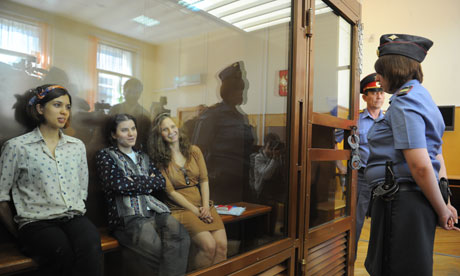
Pussy Riot band members: from lbis eft, Nadezhda Tolokonnikova, Yekaterina Samutsevich and Maria Alyokhina in court.

By the end of the first week of Pussy Riot's trial, everyone in the shabby Moscow courthouse was tired. Guards, armed with submachine guns, grabbed journalists and threw them out of the room at will. The judge, perched in front of a shabby Russian flag, refused to look at the defence. And the police dog – a 100lb black Rottweiler – no longer sat in the corner she had occupied since the start of Russia's trial of the year, but barked and foamed at the mouth as if she were in search of blood.
The trial of the three band members, jailed since March after performing a "punk prayer" against Vladimir Putin in Moscow's main cathedral, has been about more than the charges brought against them – formally, hooliganism motivated by religious hatred. In five days of testimony, lawyers and witnesses have laid bare the stark divide that has emerged in Russian society: one deeply conservative and accepting of a state that uses vague laws and bureaucracy to control its citizens, the other liberal bordering on anarchist and beginning to fight against that state with any means it can.
The court is dominated by a glass cage that holds the three women – Maria Alyokhina, who has emerged as their unofficial spokeswoman; Nadezhda Tolokonnikova, whose chiselled features have made her the band's unofficial face; and Yekaterina Samutsevich, who sits in a corner of the cage looking every bit the disgruntled punk.
After five days' sitting in the cage, some days for 10 hours at a time, the women appear exhausted. Violetta Volkova, one of their lawyers, said they were being tortured – denied food and adequate sleep. After a week of being dismissed and lectured by the judge, she could no longer hide her anger. On Friday, as the judge, Marina Syrova, denied yet another defence objection, Volkova began to shout.
Syrova, her glasses forever perched perfectly in the middle of her nose, answered tartly: "You're losing the frames of dignity."
"Those frames long haven't existed here," Volkova replied, seething.
According to Pussy Riot's lawyers, Russia has revived the Soviet-era tradition of the show trial with its case against the group. "Even in Soviet times, in Stalin's times, the courts were more honest than this one," lawyer Nikolai Polozov shouted in court. Outside, during a rare break, he explained: "This is one of the most shameful trials in modern Russia. In Soviet times, at least they followed some sort of procedure."
In one week, Syrova has refused to hear nearly all the objections brought by the defence. One objection claimed that exactly the same spelling errors were found in several witness statements, implying they were falsified.
The prosecution was allowed to call all its witnesses, mainly people who were inside the church at the time of the performance or who had viewed a video of it on YouTube. They answered questions like: "What does your Orthodox faith mean to you?", "Was the women's clothing tight?" and "What offended you about their balaclavas?"
One witness said she heard music during the band's performance in the Cathedral of Christ the Saviour, although footage shown in court showed the women singing with no live instruments. The music was added later to their viral video clip, "Virgin Mary, Chase Putin Out!"
"What kind of music did you hear?" asked the defence. "It wasn't classical – and it wasn't Orthodox," the witness replied.
The defence, meanwhile, tried to call 13 witness, including opposition leader Alexey Navalny and celebrated novelist Lyudmila Ulitskaya. Syrova only allowed them to call three. The prosecution launched the questioning of all its witnesses with the same question: Are you an Orthodox believer? When the defence tried to ask the same question of one of its three witnesses, Syrova shouted: "Question stricken."
The defence knows they are fighting a losing battle in a judicial system that is notoriously politicised. But the media battle remains. Pyotr Verzilov, Tolokonnikova's husband, has spent the trial perched in the seat closest to his wife's cage. He tweets furiously, and constantly checks how often his message is spread.
On Friday, three men climbed on to a ledge across from the courtroom windows, wearing white, purple and green balaclavas and shouted "Freedom to Pussy Riot!". There have been reports of imitation stunts carried out in other cities in Russia.
"At first, after the [anti-Putin] protests started in December, the authorities got scared that they had lost control," Polozov said. "Now they've recovered and have started to react – and the trial against Pussy Riot is the clear first step."
Every day as the trial begins, dozens of journalists gather on the stairs outside the court, repeating a tradition launched with the second trial of Mikhail Khodorkovsky, the oil tycoon and Putin foe, which was held in the same room.
Amid the crush stands Samutsevich's father and Alyokhina's mother, Natalya.
"My daughter and I had very different views about politics," Alyokhina said. "But this trial is bringing them closer."
Putin said this week that the women should not be judged "too harshly". They face up to seven years in jail if convicted but their lawyers took Putin's comments as a signal that they would not receive the full sentence. A verdict is expected next week.

War for Aleppo: battle rages in city that will determine fate of Syria

Skirmishes have broken out in Aleppo as rebels pour in to confront regime loyalists in what will be a decisive clash
A Free Syrian Army fighter reacts after his friend was shot
A rebel fighter reacts yesterday after his friend was shot by regime soldiers during clashes in central Aleppo’s Salah al-Din district.

The pitched battle for Syria's oldest city was edging ever closer to its ancient heart on Saturday, with skirmishes flaring near world-renowned landmarks and once impregnable pillars of state control.
Monuments and security buildings stand cheek-by-jowl in Aleppo, a city of huge importance to the Syrian uprising, where a grand, 1,000-year-old citadel stands not far from a much-feared interrogation dungeon. Yesterday jets were bombing the centre of the city, barely a mile away from the citadel.
Rebel groups claim that, after two weeks of bitter fighting, the city of almost 2.5 million people and linchpin of regime authority is almost within their reach.
However, as rebel reinforcements continued to pour in from elsewhere in the country ahead of an expected push early this week, regime troops were also bolstering defences in areas they continue to hold, primarily in the west and centre of the city.
The rebel force of about 6,000 fighters is being countered by a regime force thought to comprise at least double that number as well as large numbers of the loyalist Shabiha militia, many of whom come from Aleppo and have sworn to defend the city.
Rebel forces have advanced from the north-east and were on Saturday trying to dislodge loyalists who were fighting them on the approaches to the Maysaloon district. Capturing this would open access roads to the city centre, where the fighting flared on Saturday.
It would also, potentially, open a way for rebels, who maintain a foothold in the south-west of the city, to link up with the new arrivals.
Rebel groups say they plan to target the air force intelligence headquarters, among the most feared authorities in Syria's extensive security apparatus. Many of the Aleppo-based rebels claim to have spent time in the building's solitary cells and torture rooms.
"We are saving the tank shells we have for when we get access to the Air Force intelligence headquarters," said Mohammed Karim, from the rebel-held town of Azaz. "We will free the prisoners first, then destroy the building."
Other fighters said getting a foothold in the heart of the city would be difficult. "It could be another three to six months," said Hussein Shmaili, a police captain who defected.
Resting in a house on Aleppo's outer limits, Firas Abu Ayoub said: "The Shabiha are running the checkpoints. They are tough and they are are nasty and they want revenge for Zino Berri."
Berri, allegedly the chief financier and organiser of the Shabiha in Aleppo, was captured with his two sons on Wednesday and savagely gunned down following a brief show trial.
Video footage of the executions taken on mobile phones is being widely shared among rebel groups now advancing on Aleppo. Some rebel commanders are well aware of the damage the executions have done to their cause.
Partly in a bid to rectify the damage, a major from the city of al-Bab, 30km from Aleppo, took the Observer to meet a group of regime prisoners captured in a battle a fortnight ago. All were housed in a classroom on the top floor of a school.
"We were holding them before the Berris were caught," said Major Abu Mohammed al-Asmar. "And they have been treated like kings ever since they got here."
The prisoners, among them three junior Alawite officers and a Shia sergeant, slept on mattresses alongside captured Sunni conscripts. All claimed they would return home if freed.
"I just want a solution," said one of the Alawite officers. "Stability. Who really thinks about sectarianism here? Who doesn't want a state where people's rights are respected?"
None would answer a question about whether the fall of the regime or its continued rule over Syria would make a difference to their lives. And nor would they address a constant refrain among exiled Alawites: that neither rebels nor world leaders could safeguard their futures in the power vacuum that it is likely to follow the end of the regime.
"We don't want guarantees," said a second Alawite officer. "We just need peace."
Later, Major Abu Mohammed said: "We would swap all of these prisoners for just one of our men. The Alawites would return to the army. All of them."
As next week's showdown looms, fighters in the outskirts of Aleppo are continuing to ready for battle. In the early hours of Saturday, 60 members of the al-Bab brigade with bandanas and weapons they had captured from the prisoners now in the schoolhouse left for the frontline.
Aleppo's much-vaunted wealth is on clear display in many well-to-do streets and its commercial districts still appear to be functioning despite the onslaught.
Syrian leader, Bashar al-Assad, said in a statement during the week that the battle for the city would determine the future of Syria.
"That's the first thing he has said that I agree with," Major Abu Mohammed said. "It's also very important for the rest of the Middle East."

History And State of the Moroccan American Community

316298_307834789245115_118087708219825_1187500_1589073607_n

Morocco is the closest nation to Europe. Situated on the northern tip of Africa. Morocco’s population is around 32 Million. The majority of Moroccans are of Berber ancestry. Arabs make up the second largest group, followed by French, Spanish and a small number of black Africans. About 90% of the population is Muslim, trailed by a large Jewish community.
Moroccan history was heavily shaped by Arabic and Jewish influences. The Berbers inhabited the country by the end of the second millennium. During the fifth century, the Phoenicians came to Morocco and build ports along the Atlantic coast. Beginning first Century AD, the Jewish established presence in Morocco after being forced out of Spain and Portugal. Around 46 A.D. Morocco became part of the Roman Empire and later in the late seventh century, the Arabs conquest brought Islam to Morocco. After a long wave tribal war between the Berbers, Almoravids claimed victory. With Morocco united, the Arab Moroccans conquered Spain and remained for 800 years till late 1550, they were known as the Moors. France with a colonization eye on North Africa invaded Algeria in 1830, and in 1912 signed a treaty making Morocco a French protectorate. After World War II, Morocco regained independence from France in 1956.
Morocco was the first nation to recognize the fledgling United States as an independent nation in 1777. In the beginning of the American Revolution, American merchant ships were subject to attack by the Barbary Pirates while sailing the Atlantic Ocean. At this time, American envoys tried to obtain protection from European powers, but to no avail. On December 20, 1777, Morocco’s Sultan Mohammed III declared that the American merchant ships would be under the protection of the sultanate and could thus enjoy safe passage.
The Moroccan-American Treaty of Friendship stands as the U.S.’s oldest non-broken friendship treaty. Negotiated by Thomas Barclay and signed by John Adams and Thomas Jefferson in 1786, it has been in continuous effect since its ratification by Congress in July 1787.[12] Following the re-organization of the U.S. federal government upon the 1787 Constitution, President George Washington wrote a now venerated letter to the Sultan Sidi Mohamed strengthening the ties between the two countries. The United States legation (consulate) in Tangier is the first property the American government ever owned abroad.[13] The building now houses the Tangier American Legation Museum.
Officially documented Moroccan migration to America started in the middle of the twentieth century, but there is evidence that Moroccans were present in the USA even before as part of the European exploration. The first document Moroccan immigrant case was Azemmuri, a Moroccan boat pilot from Azemmour who landed in America before Columbus. It is also documented that Sephardic Moroccan Jews made their way to the United States early in the twentieth century by way of South America then moved to the North entering United States around 1910.
Today, Moroccan Americans are well established in the USA and one of the fastest growing Arab communities after the Lebanese. Official 2007 US polls show the number of Moroccans who live in the United States are over 150,000. Since the polls don’t capture the cultural ties between Moroccan Muslims and Jews, my estimate when combining the two communities is around 300,000. Based on continues research conducted by the 361 Degrees Institute, this number continues to grow as the US government grants every year 5,000 green cards to Moroccans to migrated to the United States.
As the number of Moroccan Americans continues to grow, several organizations have flourished in many states where there is a large concentration of members, New York, Texas, Virginia, Florida and California hold over 70% of the community. Surveys have showed that Moroccan Americans in these states are among the most integrated compared to other ethnic groups.
The Moroccan American community’s success depends on it’s participation in the political process. By wielding a persuasive voice that can influence policies, Moroccan Americans can assist those that need to enhance their lives and help them achieve their American dream.

Saudi man ‘buys’ Twitter followers to embarrass celebrities

A U.S.-based website advertises the selling of 2,500 Twitter followers for $5 dollars. (Al Arabiya)
A U.S.-based website advertises the selling of 2,500 Twitter followers for $5 dollars.

A Saudi man has “bought” thousands of Twitter followers in a bid to expose what he said was a form of online deception practiced by prominent users in the Kingdom who claim to have large number of followers.

Abdul Rahman al-Kharashi tweeted on July 27 that he was in a “moment of serious thinking about purchasing up to 500,000 followers as some social figures do.”
The number of Kharashi’s followers on Twitter since then jumped from 600 to 183,000.

Kharashi, identified by the Saudi-based al-Eqtisadiah newspaper as an investor in Riyadh’s stock market, accused some Saudi celebrities, including prominent religious figures, of purchasing followers on Twitter via certain agencies.

“I hope all the celebrities will clarify and declare that the numbers of their followers are not correct. Do you think any of them will brave up to admit this?,” Kharashi said in another tweet.

“I do not accuse “everyone” of buying (followers), but what I am doing proves that there are large numbers of fake followers for many celebrities,” he added in another.

Some agencies inside the kingdom reportedly charge between $70 and $270 for adding up 10,000 new followers to a customer’s Twitter account.

According to a report by al-Eqtisadiah, about 21 percent of Saudi religious figure Ayed al-Qarni’s more than 1.5 million followers on Twitter were “unreal” and more than 30 percent others were “inactive.”

The report also said that 25 percent of prominent religious figure Muhammad al-Arifi’s 2.2 million Twitter followers are “unreal” and almost 50 percent others are “inactive.”

The report, if confirmed true, would likely deal a blow to the reputation and credibility of various religious leaders who use social media forums to propagate their religious doctrines and ideas.

Outside Saudi Arabia, allegations involving the “purchase” of Twitter followers were previously addressed against U.S. Republican presidential candidates Newt Gingrich and Mitt Romney.

Romney’s Twitter account raised speculations last month when it gained more than 140,000 followers in two days, against a normal daily growth rate of 3,000 to 4,000 followers.

CNN quoted Zach Green, who monitors political activity on social media websites, as saying that someone might have added fake followers to Romney’s account in order to embarrass his campaign.