As a negotiated transition in Syria seems increasingly unlikely, we ask if there is an alternative to the UN peace plan.
|
 |
|
the uprising in Syria is approaching 16 months and the
violence continues. The southern city of Deraa was shelled overnight on Friday
killing at least 20 people.
The attack came amid further violence in the village of al-Qubair where activists say about 80 people were killed.
And while the Syrian government and the opposition blame one
another, the international community appear to be scrambling for a solution.
Hillary Clinton, the US secretary of state, met with Kofi Annan in Washington DC on Friday. And while Annan acknowledged that his peace plan was not working, he said everyone was looking for a solution. "The crisis is escalating, the violence is getting worse, the abuses are continuing .... The international community has united but it now must take that unity to a new level. We must find the will and the common ground to act and act as one," said Annan. Britain, France and the US are said to be drawing up a Security Council resolution levelling sanctions on Syria. Fred Hof, Clinton's special adviser on Syria, was in Moscow. He met Russian diplomats in a bid to persuade them to back Bashar al-Assad's removal, but with no information about a leadership change being planned in Damascus, Moscow remains defiant.
The Russian foreign ministry described the talks as "an
exchange of opinions on ways to foster a peaceful resolution in Syria" but
reaffirmed its position that Annan's plan must be fulfilled by all sides.
But as prospects for a negotiated transition in Syria appear increasingly less likely, the US is eager to co-opt Russia into applying more pressure on al-Assad. How long can a UN observer mission be sustained and is there an alternative to Annan's plan? How quickly can Syria move from tipping point to breaking point? Inside Syria, with presenter Dareen Abughaida, discusses with guests: Alexander Kuznetsov, a professor at the Russian State University for Trade and Commerce and vice president of the Geo-Arabica Center, an independent Middle East research center; Hisham Jaber, a former army general and the head of Middle East Center for Studies and Research in Beirut; and Samir Aita, a member of the Syrian Democratic Forum, which is an opposition group. |
Monday, June 11, 2012
Syria: From tipping point to breaking point?

Saturday, June 9, 2012
Obama's 'kill list'
Short-term counterterrorism efforts undermine the United States' long-term goals: to prevent safe havens for terrorists.

Washington, DC - "Don't believe what you read in the
papers," my father used to say. And as with most of the sage advice I
ignored in my youth, experience would later prove him to be right. It
eventually occurred to me when in government that if on topics I knew as
an insider the press was at least half wrong, it was unlikely that they
could be right on everything else.
And so it is with some scepticism that one should greet the latest journalistic sensation which has set tongues wagging and the blogosphere ablaze in Washington: Last Tuesday's blockbuster article in the New York Times concerning drone operations and US President Barak Obama's counterterrorism "kill list". The piece is putatively based on interviews with some three dozen current or former Obama administration advisers. As at least one wag has pointed out, an article featuring that degree of willing cooperation from the administration might more accurately be labelled a press release. Indeed, as one might expect given the context, the take-away is highly complimentary of the President and, presumably, highly advantageous to him politically, save perhaps among the sort of left-leaning hand-wringers with whom Obama's Republican political opponents would love to see him identified.
Friday, June 8, 2012
Assad regime has lost humanity – UN
Secretary general says Syrian people 'are bleeding' and that crimes against humanity may have been committed
The Syrian regime has "lost its fundamental humanity" and no longer has any legitimacy, Ban Ki-moon, the UN secretary general, said on Thursday as he described a massacre of around 90 villagers as "shocking and sickening" and demanded that the killers be brought to account.
Using some of the strongest language yet to condemn the government of Bashar al-Assad, Ban said UN monitors were shot at trying to get to the scene of the massacre on Wednesday.
He said the situation in Syria was close to breaking point and the danger of civil war was imminent and real.
The recent mass killings were "indicative of a pattern that may amount to crimes against humanity," he added. "The Syrian people are bleeding. They are angry. They want peace and dignity. Above all, they all want action."
The latest massacre, in the hamlet of al-Qubair, near Syria's fourth city of Hama, comes less than three weeks after more than 100 people were killed in Houla – an event that has sharply increased sectarian tensions and appears to be sending the country sliding towards civil war.
A loyalist civilian militia known as the Shabiha was widely accused of carrying out the Houla killings. Witnesses to the massacre in al-Qubair insisted that the Shabiha, whose members are largely from the ruling Alawite sect, had again been responsible.
Ban said the village had apparently been surrounded by Syrian forces. "The bodies of innocent civilians lying where they were, shot. Some were allegedly burned or slashed with knives," he said, adding that "each day seems to bring new additions to the grim catalogue of atrocities". Ban said it has been evident for many months that President Assad and his government "have lost all legitimacy", and added that "any regime or leader that tolerates such killing of innocents has lost its fundamental humanity".
Soon after Ban's address to the UN general assembly, Kofi Annan, the envoy he dispatched to Syria, conceded that his battered peace plan was faltering.
UN diplomats said Annan is urging the divided security council to unite and act immediately to press the Syrian government to implement his peace plan. The diplomats said Annan told council members that there must be consequences – usually a term for sanctions – for opponents of his six-point plan.
Britain's foreign secretary, William Hague, warned that the Annan peace plan was in serious trouble, and said Syria was on the edge of a worse and more bloody phase than seen so far. Hague said: "The Annan plan won't last indefinitely. Syria is clearly on the edge … of deeper violence, of deep, sectarian violence, village against village, pro-government militias against opposition areas, and of looking more like Bosnia in the 1990s than Libya last year.
"The Annan plan has clearly failed so far, but it is not dead, all hope is not lost."
Wednesday, June 6, 2012
Afghanistan suffers day of bloodshed at hands of Nato
Thirty civilians killed by suicide bombers in market and air strike that wiped out village wedding party, say officials

Afghan villagers gather at a house destroyed in a Nato raid in Logar province. Photograph: Ihsanullah Majroh/AP
On a day of deadly violence that underlined the vulnerability of Afghans, , more than 30 civilians were killed by Taliban suicide attackers and a Nato air strike on Wednesday.
Civilians are regular victims of the fighting that now affects most of Afghanistan, and last year a record number of innocent people were killed, according to UN data, but it is unusual for both parties in the conflict to exact such a toll within the span of a few hours.
In the southern city of Kandahar, a bomber struck in a market near the gates of a large military airbase. As crowds gathered at the site of the attack, a second man drove up on a motorbike and detonated another suicide vest. Together they killed 21 civilians and injured at least 50, the provincial police chief, Abdul Razzaq, said.
In Logar province, which lies south of Kabul but near the eastern border with Pakistan, a Nato air attack on a village home killed up to 18 civilians who had gathered to celebrate a wedding, local government and security officials said.
The attack targeted Taliban fighters who had taken shelter in the house, but among the bodies that angry villagers brought to the provincial capital were at least five women and seven children, according to a photographer from the Associated Press who saw the dead.
It is not clear whether the insurgents sought permission to enter the house, or forced their way in at gunpoint. There were also at least half a dozen militants among those killed, the police and intelligence services said, but villagers were only mourning their own dead.
"Last night in Baraki Barak district there was fighting between the Taliban and foreigners and the Taliban hid themselves in the house of a man called Basir Akhunzada, an elder of the people," said Abdul Wali, the chief of the Logar provincial council, who discussed the bombing by phone from Logar.
"Akhundzada was killed, his brother Qayoum Akhunzada, Qayoum's wife. Altogether 18 civilians from his family were killed."
An official from the provincial governor's office confirmed that 18 civilians died. "Not all the people were from his immediate family, because there was a wedding ceremony going on, so there were many relatives staying there," said adviser Mirwais Mir Zakhwal.
Nato forces said they had requested an air strike in Baraki Barak after troops were attacked with guns and rocket-propelled grenades, but listed "multiple insurgents" as the only dead. A spokesman said the Nato-led coalition was looking into allegations of civilian casualties.
"We are still looking into the circumstances to try and understand what took place there, and the nature of the casualties," said Lieutenant Commander Brian Badura.
The Taliban claimed responsibility for the attack in Kandahar but said it was aimed at the base, Nato's largest headquarters in the south, and claimed they killed only foreigners. But the bombers targeted an area with a bazaar and bus station where there are few foreigners. Afghan security and health officials said the dead and injured were all Afghans.
"I was sitting in my shop, close to this gate, and heard a small explosion, then I saw people were left killed and wounded on the ground," said Shamsullah, a young shopkeeper injured in the blast. "After a few minutes a motorbike came and I just heard a very big explosion and when I opened my eyes I was in a hospital."
The use of a second bomb to increase the toll – by targeting security forces, medical services and bystanders gathered around victims of a first blast – is unusual in Afghanistan. A spokesman for the Kandahar provincial governor, Jawed Faisal, said he could remember only two other attacks in the city, which is a regular insurgent target, that used secondary bombs. One was in 2007 and one in 2010.
The attack, which happened as four provincial governors were meeting at the base, was condemned by Afghanistan's president, Hamid Karzai, the US embassy and by the Nato-led coalition.
Karzai has long criticised Nato for not doing enough to prevent the killings of innocent civilians, which have become a major irritant in relations with his foreign partners.
He warned earlier this month that the deaths could undermine a deal laying the framework for ties with the US after 2014, when most foreign combat forces will have left Afghanistan.
His critics in turn say the Afghan president should be stronger in his condemnation of the Taliban's role in pushing up the country's civilian casualty toll. Insurgents are now responsible for more than three-quarters of these deaths, according to UN figures.
Tuesday, June 5, 2012
US says drone killed al-Qaeda commander
Abu Yahya al-Libi, targeted in Pakistan's tribal region, described as group's second-in-command by US officials.
US officials said on Tuesday that the Libyan-born al-Libi had recently been considered by US counterterrorism experts as the No 2 in the core al-Qaeda group led by Ayman al-Zawahiri.
It is difficult to independently confirm the reports of al-Libi's death. However, if the US claims are true, then al-Libi would be the latest of more than a dozen high-ranking al-Qaeda commanders killed during the past year.
The US state department had set a $1m reward for information leading to al-Libi.
US and Pakistan sources said on Monday that al-Libi was the target of a deadly drone attack in Pakistan's North Waziristan region. However, the US sources could not confirm whether he was killed in that raid.
Zawahiri has headed the group since al-Qaeda's founder, Osama bin Laden, was killed last year in a US commando raid on his hideout in Pakistan.
'Versatile leader'
A US official described al-Libi as "among al-Qaeda's most experienced and versatile leaders", saying that he "played a critical role in the group's planning against the West, providing oversight of the external operations efforts".
The drone raid that targeted al-Libi killed 15 people, according to Pakistani officials, who said more than half of the victims were "foreigners", most of them Arabs.
It was the third drone attack in as many days in Pakistan's tribal regions. A bombing on Saturday killed four people, and another on Sunday killed 10 more.
The Pakistani foreign ministry summoned Richard Hoagland, the US charge d'affaires in Islamabad, on Tuesday to convey the "government's serious concern regarding drone strikes in Pakistani territory".
A commander in North Waziristan closely associated with foreign fighters insisted that al-Libi was alive.
"He has not been killed," he told Reuters news agency. "This is not the first time claims have been made about his death. The Americans are suffering heavy losses in Afghanistan so they have resorted to making false claims."
Another local Taliban commander said the attack killed al-Libi's bodyguard and his driver, but not the al-Qaeda commander himself, according to the Associated Press news agency.
Bagram base detainee
Al-Libi reportedly travelled to Afghanistan in the 1990s. He was captured in 2002 and detained at Bagram airbase in Afghanistan.
But he escaped in 2005, along with three other detainees, and was never recaptured. He is the only one of the four still at large; the rest have either been captured or killed.
Al-Libi was elevated to al-Qaeda's number-two position last year, after the US raid in Pakistan which killed Osama bin Laden.
He was not considered a skilled military commander - his value to the group was mostly as a propagandist. He appeared frequently in the group's recruitment videos.
This is not the first time the US has reported him dead: al-Libi was initially believed to be the target of a drone attack in December 2009, but the actual victim was Saleh al-Somali, dubbed al-Qaeda's "external operations" chief.
Sunday, June 3, 2012
Iran warns Israel of 'lightning' reply to any attack
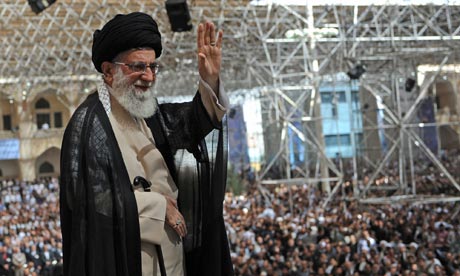
 Iran's supreme leader, Ali Khamenei, has threatened a "lightning response" to any Israeli attack and warned that sanctions would fail to curb his country's nuclear programme and only deepen its "hatred of the west".
The angry rhetoric is routine for Iran's clerical leadership but had particular significance as it came between rounds of negotiations between Tehran and the world's major powers over Iranian nuclear aspirations.
Western officials were hoping to hear conciliatory notes in the supreme leader's speech, delivered on the anniversary of the death of his predecessor, Ruhollah Khomeini, which is often the occasion of policy announcements by the Tehran leadership.
Mildly positive language towards Barack Obama in a Khamenei speech delivered in March raised hopes for a diplomatic way out of the nuclear impasse, but with a third round of talks due in Moscow later this month, there was no encouragement for reconciliation in today's address.
"The obstacles enemies are creating in our path won't have any effect. Sanctions are ineffective. Sanctions can't stop the Iranian nation from moving forward," Khamenei said at Khomeini's mausoleum south of Tehran. "The only effect these unilateral and multilateral sanctions have on the Iranian nation is that they deepen hatred and animosity toward the west in the heart of our people."
Turning towards the threat of an Israeli military strike against Iran's nuclear sites, the ayatollah warned: "Should they take any wrong step, any inappropriate move, it will fall on their heads like lightning."
Khamenei's comments come a week after the head of the Iranian Atomic Energy Organisation, Fereydoun Abbasi-Davani, declared there was no need for Iran to stop production of 20% enriched uranium, something that had been sought by international negotiators at the last round of discussions in Baghdad last month.
The Baghdad talks ended without significant progress. A six-nation group of negotiators from the US, China, UK, France, Germany, and Russia, offered reactor fuel, nuclear safety support and parts for commercial airliners in return for a suspension of 20% enriched uranium. The Iranians said Tehran was willing to discuss 20% uranium, but made no mention of suspension and demanded international recognition of its right to enrich uranium.
Western officials say the six UN security council resolutions calling for Iran to suspend enrichment – which can produce fuel for both power stations and nuclear weapons – could be reversed, but only as part of a final settlement under which Iran agrees to undergo sufficiently thorough monitoring to convince the international community it does not have a military programme.
Officials from the six-nation negotiating group are considering how to prevent a collapse of the diplomatic process in Moscow on 18 June, which would increase the likelihood of an Israeli strike. So far western officials have ruled out the offer of a relaxation in sanctions in return for the end of 20% enrichment.
"The Iranians have given nothing, no concessions since 2006. Why reward that with further concessions from our side?," a senior European diplomat said.
Further US banking sanctions are due to take effect this month, followed by an EU oil embargo on 1 July.
Western determination to impose sanctions has been buoyed by the unexpectedly sharp rise in Iraqi oil production, which is likely to dampen the effect of sanctions and tensions with Iran on the global oil price.
Saturday, June 2, 2012
Mubarak sentenced to life in jail
 Egypt's ex-president Hosni Mubarak was sentenced to life imprisonment on Saturday, the Cairo Criminal Court said.
Presiding Judge Ahmed Refaat announced that after 49 times of trial, the Cairo Criminal Court decided to sentence Mubarak and former interior minister Habib Adli to life terms for charges of killing protesters in the massive demonstration last year.
Adli's six assistants were acquitted, said Refaat.
"The communications among the defendants during the revolution for the order of killing protesters weren't proved, some evidences were corrupted before reaching the hands of the court," Refaat said.
The presiding judge made a brief speech before announcing the verdict, reminding people of the uprising that had ousted the corrupted regime and defended protestors who called for basic human rights.
The demonstrators called for a place to shelter after they lived in slums drinking dirty water, and a job to afford their family, Refaat added.
The uprising that toppled those who made Egypt live in darkness without hope or aspiration was peaceful, and it turned the country to the bright side, he noted.
Egypt's General Prosecutor Abdel Maguid Mahmoud decided last Saturday to transfer Mubarak from the International Medical Center on Cairo-Ismailia road, where he spent the whole period of imprisonment since the trial started in last August, to the Torah prison.
Charges of corruption and exploiting public money against Mubarak's sons, Alaa and Gamal, and fugitive businessman Hussein Salem were dropped due to the expiry of a statute of limitations.
Mubarak and his sons were charged of purchasing villas owned by Hussein Salem at very low prices against offering him facilities to possess huge pieces of land in the Red Sea resort of Sharm el- Sheikh.
Also, Mubarak was acquitted in one of the cases related to using his power to achieve gains.
After the verdict, Mubarak was transferred by plane to Torah prison to serve his life sentence. His health reportedly worsened after a few minutes of his arrival. His two sons, Adli and the former interior minister's six aids were moved on another helicopter to the same prison as a precautious measure.
Clashes erupted between lawyers and families of those killed in the demonstration after the verdict in the courtroom, leaving some injuries.
The families of victims chanted "people want the judiciary cleansed," describing the verdict as "void, void." Security forces deployed in the court calmed the clashes and managed to regain order.
In front of the court, some Egyptians fired fireworks, singing and dancing in an expression of their excitement for a fair verdict, while others wished to sentence Mubarak and his aids to death.
Mubarak's supporters threw rocks at riot police standing guard outside the court and were chased by security forces.
Some of martyrs' families flocked Tahrir Square to protest on the verdict and express their dissatisfaction. They also called for executing the defendants.
"Acquitting the seniors of Adli is out of expectations," said Ahmad Khalil, 28, who was among those waiting outside the court.
In Suez, feelings of angry overwhelmed the families of the murdered protestors. Karim Essam, 56, whose son was killed in the early days of the uprising, said that "The trial acquitted the interior ministry's senior officials and sons of Mubarak so they can go out and resume their crimes."
Sairah Murad, a 37-year-old physician who had received injured protesters in a governmental hospital during the unrest, said that "Mubarak was not the problem. He is going to die anyway. But how couldn't the court proved his sons are guilty in the killings acts? "
Arafat Amin, secretary general of Al-Karamah party in Sinia, told Xinhua," I think the verdict is fair, it touched the head of the snake, Adli's assistants were just taking orders from their chief."
Emad Al-bake, a political activist, condemned the court decision, saying "the six senior officials didn't deserve to be acquitted."
Akram Hossam, a political researcher in the Middle East Center for political studies, said "the verdict is more than my expectations. I expected for Mubarak less years." "I think both Mubarak and Adli will appeal on the verdict, and their sentence will be mitigated," added Hossam.
According to the state TV, the defendants could appeal on the verdict in 60 days after its announcement.
Subscribe to:
Posts (Atom)